Tag: writing life

  • Fatigue, A Stalled Book, and Art in the House

    Oy veh. What a week the last few weeks have been. Stress levels haven’t been just through the roof, they’ve been somewhere out beyond the orbit of the Moon, so my body’s said, “OK, I’ve had enough of this fun.” Welcome to knock-you-flat-on-your-back fatigue. To quote the lyrics from the ’70’s rock band Spirit, “It’s nature’s way of telling you something’s wrong.” Boy, howdy.

    That Stalled Book

    I’d like to blame it all on the draft of book #3. Progress has come to a screeching, grinding halt. I shouldn’t be surprised: I knew, even as I was writing the second draft, that there were significant problems. Then my writers’ group found what they found, and my own read-through and analysis found even more.

    OK, fine. I’ll interview my characters. That’s a technique that’s helped before. It sounds schizophrenic, I know. They’re my inventions, but I’m going to interview them?

    It’s kind of like “method acting”: putting on their personality while an anonymous interviewer peppers them with uncomfortable questions. One of my characters got so annoyed she dropped the f-bomb several times! Well, that’s who she is.

    So that helped. But not enough. The problems are WAY deeper, especially with two story-lines, and so far I don’t have any answers. SIGH.

    Head, meet brick wall. Oh, you’ve already been introduced? Well, meet it again! THUD.

    And this is a job I WANT to do?

    Yeah, it is.

    I know the right answers, the right insights will come eventually. I just hope it will be before the year 2525. “If man is still alive. If woman has survived….”

    The Old House

    The news hasn’t all been bad, though. Remodeling work has started on the old house. The old flooring has been ripped out, the new tile is going down, replacement exterior doors are almost on order, the new exterior paint colors have been selected. And I’m not living there while this is all happening.

    That should be a stress reliever. Yeah, well. When the house is sold….

    Art in the House

    Who’s Art? No, not Art. Art, like in artwork. Week by week I’ve been putting up more and more of the stuff that’s been in boxes for the last six to ten years. Or longer. Like this batik that my Dad bought ages ago and no one ever had a place to put it.

    Peacock batik

    It brightens up the powder bath, don’t you think?

    This Dancing Rama batik is one that I hung in my house in Oklahoma, but it’s been in storage since I left.
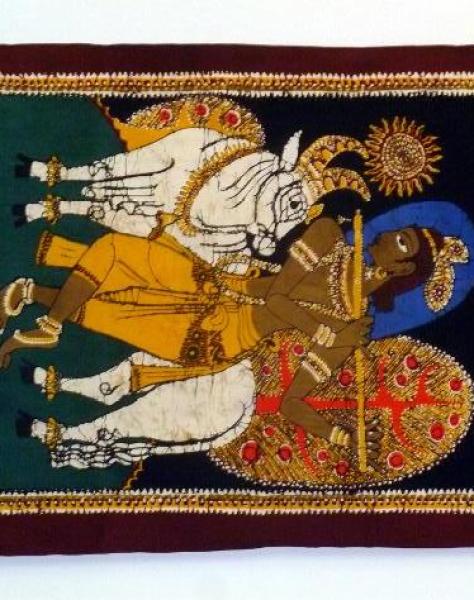
    Dancing Rama batik

    But the pieces I really wanted to get up were two stained-glass windows.

    Stained glass windows

    My Dad and I found them in the feed room of an old chicken coop that used to be on our property in Denver. We had no idea where they’d come from or how old they were. A neighbor who did stained glass rehabilitated them, and years later they hung in a north-facing window in the house my parents moved to. But then they went into storage and had rarely seen the light of day until a few months ago.

    I asked my cabinet builder, Jeff McClain, to tighten up the frames a bit.

    Stained glass windows close-up

    Speaking of Jeff, he also delivered this display cabinet for the “oriental” bedroom recently.

    Oriental bedroom display cabinet

    Little by little, the house comes together.

    Save

    Save

  • Book 3, Starting Draft 2

    One of the things writer Anne Lamott is famous for is her advice, “Give yourself permission to write a shitty first draft.” To me that’s a kind of liberation theology for writers, but that’s a subject for another time. Today I’m going to continue to pull back the curtain on my writing process, at least as it relates to getting all the scenes in order for the second draft of this book.

    So: “Give yourself permission….” Done.

    “Write a shitty first draft.” Done.

    OK, maybe “shitty” is a relative term, but while my read-through of the first draft got a “not bad” rating, as I wrote last time there were problems with the timeline, that is, the sequence of events in the plot. Timeline is especially critical for this book for two reasons.

    • One, it needs to end at a certain time of year in order to take advantage of certain weather phenomena in Dallas.
      • One-a, there are other events in the book that take place outdoors. They needed to fall at times of the year when they could take place outdoors or something would have to change.
    • Two, this book, like its predecessors The Eternity Plague and Chrysalis, has five–count ’em, five–interconnected story lines happening at once, so the sequencing of the events in each story line needs to be right.

    Since I knew I had problems, and on top of that I had about 50 scenes that weren’t organized into chapters, I had two tasks that needed to happen pretty much in parallel: figure out the overall timeline and get those scenes into chapters. Then I could look for the scenes I already knew were out of order and identify where they should have gone.

    Because I’m a “plotter”–that is, I work from an outline–building an updated outline of the story would take care of those tasks. I do this using Microsoft Excel. Yes, the spreadsheet program. I have a column for the chapter and scene number, a column for each major and key minor character, and a column for the timeline. With Excel, I can have as many columns as I want and not have to worry about trying to fit them all into one page, even in landscape format, which is what I’d have to do if I tried to use a Word table.

    Since there are five major characters–Janet Hogan, the protagonist; Lisa Lange; Sarah Green-Dale; Reverend Will Baxter; and Lew Crandall–that’s where the spreadsheet started. Then I added the key minor characters associated with them, plus one for “Others.” To make them easier to see, I color coded the cells on the spreadsheet row with the characters’ names: pink for Janet and her crew, red for Lisa and her crew, etc.

    Instead of one chapter/scene column, I put two in this time: one for where each scene fell in draft 1 and the other for where they needed to go in draft 2. Next, I added one column for how each scene related in time to the one before it, and one more for what calendar month and year that scene fell in.

    Then, on the row for each scene, I wrote a brief description of what happened in the scene in the column or columns for the characters involved.

    The end result: 18 columns by 142 rows! In other words, this, taped up on my guest bedroom wall:

    The Draft 2 outline

    Yikes. That’s three landscape-format pages wide by 10 pages tall! It’s so big, I had to split it into two 3-pages-wide by 5-pages-tall sets. This technique is NOT for everyone!

    Before I printed this monster out, I did that sorting of which scene needed to go where. Here’s an example from the beginning of the novel.

    Chapter 1 scene sequence

    Outlined in blue, you can see how I planned to bring three scenes from chapter 2 forward into chapter 1.

    I also worked out the timing. Here’s the timeline for those same scenes.

    Chapter 1 timeline

    But aren’t those August 26th scenes out of order? Well, by strict definition, yes, but hey, I’m a writer–I can finesse that! “Two weeks earlier…”

    Great! Now I had a plan and could start editing.

    But of course, no plan survives first contact with reality, and that’s what happened today. I was chugging along, working on what was supposed to be scenes 7 and 8 of chapter 1 when I discovered that they needed to go before the three scenes I’d pulled in from chapter 2, not after! D’oh! OK, that’s an easy fix.

    These are some of the reasons why the first draft of a novel should NEVER be the final draft.

    And you thought writing a novel was easy.

    Save

  • Book 3, Draft 1

    Woman reading a book
    Image courtesy of Marin / FreeDigitalPhotos.net

    Last night I finished my first complete read-through of the first draft of book #3 (working title, Guardians, although I’m considering Wild Spread as an alternative). (No, that’s not me over there on the right. My ideal reader, maybe. At least her interest level looks right.) I’ve got almost 10 pages of hand-written notes of things to check, fix, delete, etc.

    Overall verdict: not bad.

    There are some scenes that are way out of position. There’s a place where one of my secondary characters chrysalizes, then a few chapters later appears again in her unchanged, original form, as if the chrysalization never happened. Oops. Well, that’s the sort of thing that happens in a first draft. The fix should be easy: delete the sentence that reports the chrysalization. I can still end that scene in a way that will make readers want to find out whether what Amanda fears will happen to her or not. (Hint: it–NO, I’m not telling!)

    My barber asked me yesterday if I ever forget what I’d written earlier in the draft. Heck, yeah! Happens all the time. Having an outline helps but there are always details about something I wrote months ago that get forgotten or contradicted later. Maybe other writers can keep all of that straight but in a 110,000+ word draft, written over the course of six or seven months, for me, fuhgeddaboudit.

    This is just one reason why first drafts should never ever be final drafts!

    I still need to go though the draft and sort out the timeline. That’s especially important this time because the final scene has to take place in May or June. And since the book opens at a specific time of year, right after the end of Chrysalis, everything else needs to happen at the right time or the last scene could end up in some other month, when the weather pattern that’s critical to the end of the story doesn’t happen, or doesn’t happen so much, in Dallas. (That’s a teaser.)

    I’m actually looking forward to getting started on Draft 2. I know lots of writers who dislike, hate, despise, you pick the negative verb, revising. Not me. I enjoy it. While it’s a different kind of process, and takes a different kind of creativity than writing that first draft is/does, seeing the work get better is a reward in itself. I get a real feeling of satisfaction at the end of a day of editing when I know the story is better than it was before I started.

    Draft 2 is what my writers’ group will get. (Get ready, guys and gals. When it starts to come your way, it’s going to come in big chunks!) Their feedback will help me create Draft 3, which is what I plan to send to my still-to-be-selected editor and beta readers. Draft 4, created from their feedback, should be what goes to CreateSpace and Smashwords to be published.

    When will that be? I don’t know. I’d hoped to get this book done and out by the end of this year, but I don’t see that happening now. If nothing else, since I don’t know who’s going to edit the book, I don’t know what his or her timeline will be: when they’ll be able to take it, how long they’ll need, etc. All in good time. Things are moving forward, and that’s what matters.

    Time to get busy.

  • Critique Groups: Saying Good-Bye

    The Cochise Writers’ Group, which I co-founded with Cappy Hanson, has gone through phases of growth and contraction, as every group does. We’ve been as small as four members, and as large as 17! We hit that number about a year ago and it became obvious very quickly that if we didn’t do something, the group was going to be unmanageable. The first thing we did was close the group to new members.

    Our only saving grace was that not everyone in the group was submitting work. A lot of the new members did initially, in that burst of enthusiasm that comes with being new at something, but that tapered off over the months. Now we’ve got about half a dozen members who submit work more or less regularly, and that makes things easier to handle, both from a critique standpoint and from a management one.

    But as the months went by, it became clear to us that some of our longer-term members weren’t actually contributing much. Their attendance was spotty, they only provided critiques once in a while, and they weren’t submitting work. Something had to change.

    Now, we’d been pretty tolerant with these folks. Some had been regulars at our every-two-weeks meetings, and had contributed work in the past. But now they were dealing with medical issues, either their own or their aging parents’, or there were work issues, or other things, and for the sake of keeping them engaged in the writing process, at least a little, we’d let them remain members. That was fine while those problems were active, but as they resolved themselves, these “writers” now weren’t living up to the expectations document we’d put together over the summer.

    So Cappy and I looked over our membership list just after Christmas and picked out half a dozen people whom we felt we needed to say, “Time to fish or cut bait.” We each took three and either talked to them in person or over the phone. No e-mails; this all had to be personal.

    The message was this: You have until the end of March to do the following, or we’re going to have to ask you to leave. (1) Start attending regularly, even if that’s only at one of our two locations. (We meet in two different towns, Sierra Vista and Bisbee, which are about 30 road miles apart. Some of us drive 60 miles or more, round trip, to get to our meetings. This wouldn’t be acceptable, or even necessary, in a big city. In a rural area, it’s just the way things are.)The end of a dream

    (2) Start critiquing everything the other members send out. If you have to send your critiques back via e-mail, that’s fine. If you have to give them to one of the members who goes to all meetings so they can deliver them in person two weeks later, that’s fine. But do the work.

    (3) Start submitting, or at least participate in the Google Docs spreadsheet one of us created to record your daily word count, how much time you spent working, or whatever. In other words, we’re a working writers’ group: prove to us that you’re writing.

    That got some of the people to step up.  Some took that necessary deep breath and made their first submission. Others, however, did little or nothing.

    And so, on Tuesday night, Cappy and I took the first of those people aside and gave her the news: we were asking her to leave the group.

    This is never easy. We’ve only had to do it once before. The truth is, though, that besides actual writers, critique groups attract other people: wannabes, dreamers, procrastinators, lookie-loos, groupies, people looking for some kind of social contact. Dead weight, in other words, for a working group. Those people have to be identified, given a chance to change, and if they fail or refuse, let go.

    It’s not easy. It’s never fun.

    And it’s absolutely necessary.

  • Tucson Festival of Books, Day 2

    Got home late from TFoB yesterday, so now I’m catching up.

    Did I say yesterday there were crowds at the Festival? Let me show you.

    TFoB crowds

    Did I say there was food? (And crowds)

    TFoB food

    That’s just one side of one of the two food courts.

    And there were panels. LOTS of panels. From one on the “first folio” printings of all of Shakespeare’s plays, to Kick-Ass Women of Sci-Fi, to Surviving the Future (panel below),

    L-R: Austin Aslan, Paolo Bacigalupi, Charlie Jane Anders, Jonathan Maberry
    L-R: Austin Aslan, Paolo Bacigalupi, Charlie Jane Anders, Jonathan Maberry

    to Ask a Sci-Fi Editor, to My Hero Can Beat Up Your Hero (panel below).

    My Hero panel
    L-R: Paolo Bacigalupi, Greg Bear, Sam Sykes

    Did I have a good time? Writer-pal Lisa Vogel and I did, even standing in line.

    Lisa & Ross

    Yeah, definitely going again next year.

    Save

  • 2016 Tucson Festival of Books, Day 1

    Day 1 of the 2016 Tucson Festival of Books is in, well, the books. (Sorry.) (Not really.) Hosted on the University of Arizona campus, it’s the fourth largest book fair in the entire country, and 99% of it is FREE! (Pictures tomorrow, I promise!)

    Check out this (very) partial list of authors in attendance: Paolo Bacigalupi, Greg Bear, Terry Brooks (yes, the Sword of Shannara creator), Jared Diamond, Diana Gabaldon (yes, the Outlander creator), Tucson writer J. A. Jance, Jeff Mariotte, Sierra Vista’s own Yvonne Navarro and Weston Ochse, cartoonist Stephan Pastis (creator of the Pearls Before Swine strip), R. L. Stine (creator of the Goosebumps kids’ series), Chuck Wendig, and over 100 others. Don’t recognize many of the names? That’s OK: there are lots of authors I haven’t heard of either who are on panels I went to today, and I learned from and enjoyed every one. Some of these folks, and others I didn’t mention, are people I’ve met at the Tucson Science Fiction convention (TusCon) in the fall.

    I might even have found a cover artist for my next book–the one after I finish The Eternity Plague series.

    Now, to be honest, the quality of the panels was uneven. “Kick-Ass Women of Sci-Fi” was terrific while “Layering Laughs: Writing Comedy” not so much because the “moderator” made himself too much the center of attention, rather than letting the authors really talk about what they do. That’s always a risk with these panels at any conference or convention, so you just have to go with it and get whatever you can out of the talk.

    Besides all of the presentations, there are hundreds of tents for all kinds of organizations–booksellers (of course), authors (of course), publishers (of course), editors (of course), but also schools, religious groups, health and wellness groups, the National Park Service, Native American groups, newspapers, radio and TV stations, basically anyone who wants to get visibility with so many people and can come up with the money to pay for a tent (or several). This is how I found out about TusCon.

    It’s a GREAT event. How a writer could NOT go to this event is mostly beyond me. (OK, I’ll give a pass to folks who don’t like crowds. After all, over 100,000 will attend over the two days of the Festival.)

    If I have one beef, it’s that indie authors still get short shrift. Yes, they can reserve some time at one of two big, well-placed selling/signing tents (an improvement: it used to be one small, hidden one), but they aren’t invited to be presenters, no matter how well they’re selling or whether they started their career in traditional publishing or have been sought out by traditional publishers. That’s just wrong: we’re 25% of the market, after all! More, in some genres.

    So, it’s up “early” again tomorrow to make the drive back to Tucson.

    Speaking of the drive, something significant happened on the way up this morning: my car turned over 200,000 miles on the odometer. Here’s the proof.

    (Kids, don’t try this at home. Well, how would you do almost 80 miles per hour at home anyway?)


  • Writers’/Critique Groups: Right for Every Writer?

    My writers’/critique group, the Cochise Writers’ Group, has been going through some changes lately and that’s gotten me thinking about critique groups in general: their puCritique grouprpose, size, makeup, and so on. This post starts an occasional series as I collect my thoughts and observations about them.

    One of the most argued about questions in writer-dom is whether writers should join critique groups or not. There are some people who are absolutely certain they know what the right answer is for everyone. Multi-published author Dean Wesley Smith is death on writers’ groups. I guess he had a bad experience with one once, but if he did, that’s not a sufficient reason–not a reason at all, really–to declare all groups bad all the time for all writers.

    Here’s the thing. (Check out this blinding grasp of the obvious.) Every writer is different: different personality, different needs, different skill level, different… well, different everything.

    So is every critique group. Some are big, some are small, some in-between. Some are made up of advanced writers, some of newbies, some a mix. Some focus on one genre, some will critique anything. Some are egalitarian, with everyone contributing to the best of their ability; some are dominated by a single individual. Some (often those dominated by one person) can be destructive; some–the best–work hard to help each other get better. Some meet weekly, some biweekly, some every month. Some meet in person, others are online.

    And that’s what makes finding the right group a challenge for writers, presuming, of course, that they think they want and need such a group–by no means a given. How many groups are there close–whatever that might mean–to a given writer? Do they meet at a convenient time? How do they work? How much work can a writer submit? How quickly will it get reviewed?

    Very important: What’s the personality of the group: welcoming or not, helpful or critical, constructive or destructive?

    Most important: What does the writer want to get out of being a part of the group? And what do they hope to contribute to it?

    There’s no “right” answer for all writers, just a “right-for-now” answer for each writer, and each writer has to figure that out for themselves.


  • The Art of War for Writers

    Small 4-star rating on dark blue background


    Put James Scott Bell’s The Art of War for Writers next to Strunk and White’s The Elements of Style on your bookshelf—or better, within easy reach! It’s that good.

    Using famous and long-ago Chinese general Sun Tzu’s The Art of War as his model, Bell presents vital and valuable information for writers in bite-size chunks. These nourishing and digestible non-chicken nuggets add up to a lot of chapters, yet only two are longer than five pages.

    That’s what makes them so useful: you can read a few, set the book aside to ponder them, and then come back without being overwhelmed with information. These chapter titles will give you a sense of what I mean:

    • From Part I, “Reconnaissance”: 21. Put heart into everything you write.
    • From Part II, “Tactics”: 36. Speed is the essence of the opening.
    • From Part III, “Strategy”: 59. Network according to the law of reciprocity.

    So if I think this is such a great book, why give it only four stars? Just one thing. The book was published in 2009, as the independent publishing revolution was just taking hold. Bell’s thoughts about indie publishing reflect the times, so he puts his emphasis on finding a path to what we now call traditional publication. Much has changed in six years, and if Bell were to update the book (let’s hope he will!), I’m sure his tone would change—and there’d be even more chapters to guide writers through the minefields of the indie-publishing world. As the title of chapter 23 says, “The writer of potential greatness settles not for ‘mere fiction.’”

    Highly recommended.

  • Critique Technique, Part 1B — Life on the Other Side of the Critique

    In addition to taking care to develop your own skills as a critiquer, some of which I discussed in Part 1A, there’s one other person you need to always be mindful of: the person whose work you’re reviewing.

    Think about how you react when your work is being critiqued. In 2012, Becky Levine wrote a blog post called Critique Comments: Remembering to Give Them Time. She advised letting a critique you receive sit and percolate, or ferment, or something (my words, her concept) before responding to it. Of course, there’s going to be the natural, defensive first response, even if the comments aren’t negative. Any suggestion to do things a different way is going to get that. That’s a reaction that needs to be put aside, taken off the hot stove and allowed to cool, as it were. It might be wrong.

    Or it might not.

    But in the heat of that first reactive moment, it can be hard to tell.

    I’ve been there. One of my writers’ group members didn’t read the kind of fiction I write (science fiction), so some of the techniques of the genre confused her. Sometimes she’d forget something that was explained a half page or two pages before. Sometimes context eluded her. So she’d comment on whatever confused her, and my first reaction was often frustration. But then… sometimes… I’d take another look and… well, yeah, I could have written that better.

    That’s a Person Over There!

    Woman with a headache

    That’s a good lesson. And it leads to this reminder: when you’re a critiquer, it’s important to remember that the work you’re reading was written by a human being. If you’re going to deliver that critique in person, you’ll see their initial reaction up close and personal. If you’re delivering it online, you may not, in which case it’s even more important to remember the humanity of the person on the receiving side of that critique. The anonymity, or at least physical separation, of the internet is no excuse for being a jerk.

    Or worse.

    Think about how you’d feel—or have felt—when you got a critique like that.

    I’ve read many first drafts of new writers’ first novels. They’re rough. Of course they are, they’re first drafts! The fact that they can often be rough for hundreds of pages is still no excuse for me to be hard on the author. It’s a first draft. If the writer’s gotten that far into the piece, they’ve got the talent to string together a complete novel. And for the first time in their life, they’re trying to do it. Yes, there will be a lot of work yet to do: drafts 2 and 3 and 4 and…. This is just the first one.

    But if I do my job wrong, if I’m too hard on that new author, maybe there won’t be a draft 2 and a draft 3 and so on until it’s done. Maybe they’ll decide it isn’t worth the continued abuse (their thought, not my intent!) to go on to draft 2 and draft 3 and….

    Which would be an absolute shame.

    Dif’rent Strokes for Dif’rent Folks

    There’s one other thing to think about. Different people learn and absorb information differently. Some do best reading new information. Others need to see it demonstrated. Still others need to hear it. And yet others learn best by doing a particular task. In-person and online critique group reviews tend to be written, with an oral summary at the group meeting. Critiques provided via a critique web site are almost always exclusively written.

    But what happens if that doesn’t connect with the way the author learns best? I currently have a critique group member who does a lot better if he hears the individual comments. Written comments and guides tend to go in one eye and out the other with him. One-on-one, step-by-step reviews with him doing the editing in real time takes time, but if the time spent turns out to make a big different in the areas he’s having trouble with, it’ll be time well spent.

    Our Responsibility

    As critiquers, we have to remember that we hold something very fragile in our hands—a new (or not so new) writer’s ego, their hopes, their dreams—and if we’re needlessly harsh, if we only criticize without offering suggestions for ways to get better results, we not only do no good, we may do harm.

    That isn’t to say we can’t or shouldn’t point out what isn’t working, or isn’t working as well as it could. It’s not to say we need to sugarcoat everything, or be so namby-pamby or vague that what we say is as good as useless.

    Writers do need to develop a thick skin. Once their work is published, they’re going to get feedback, and those one- and two-star reviews can sting. The internet’s trolls can be especially cruel.

    But that does not mean we critiquers should be.

    It does mean that we should always remember what it’s like to be on the receiving end of a critique and do our work accordingly.

    What are your thoughts about how to put yourself in the place of that other author when you’re critiquing their work? How do you approach presenting your critique, especially when the author has a lot of work to do? Please share your thoughts, suggestions, and ideas in the comments box below.

  • Great Stuff for Writers, June 24, 2013

    Major changes coming again to my Great Stuff posts. Starting next month, I’m going to again scale way back on these posts, for a lot of reasons:

    • Technical buffoonery on my part that made the Twitter links back to them produce “page not found” errors that I didn’t know about (but should have). I know better now.
    • Time. This is the main reason. It just takes too much time to produce these posts in the current form.
    • Others are doing it better. They have bigger audiences. Another reason why my time isn’t being well spent on these posts.
    • I need to rethink my social media involvement, such as it is.

    So, July 1st, when Google Reader dies, is a good time for a reevaluation and restructuring on these posts. What will that be? Stay tuned.

    Meanwhile, here’s the Great Stuff for Writers from the past week.

    CRAFT

    The unreliable narrator is one of the most interesting kinds of characters in fiction. In Who Ya Gonna Trust, editor Dave King discusses how four writers—Agatha Christie, Reginald Hill, Dorothy Sayers (all mystery writers), and J. D. Salinger—used their narrators in different ways to reveal different things about their characters.

    James Scott Bell (@jamesscottbell) uses two movies, 12 Angry Men and City Slickers (now there’s a contrast for you), to illustrate how not only is conflict necessary to the story, it’s better if there’s conflict between every important character in the story. And by conflict, Bell means potential death—physical, psychological, professional. Okay, so what is A Key to Creating Conflict in Fiction? Orchestration of the suspense: will he or won’t he… survive, retain his moral values, etc.?

    Since the protagonists of my first two books are both women, I was interested in Andrea Lochen’s Female Protagonists: Do They Need to be Friend Material? Now, I don’t read to find friends (is doing so “a woman thing” as Lochen seems to suggest?) and it was interesting to note that women writers are apparently taught, blatantly and subtly, that their characters, especially their female leads, “should be” friend material. Lochen closes by writing, “Maybe in the future this notion of female characters needing to be agreeable will be dispelled. Maybe their personalities will run the gamut, just like real-life women. But until then, my advice is to focus less on making your characters likeable and more on making them interesting and believable.” Sad, isn’t it, that this needs to be said.

    Henry McLaughlin’s brief What Does Your Hero Yearn For? touches on a key piece of character development that gets far too little attention, I think. A yearning is a deep-seated, strongly-felt but perhaps not recognized or understood need a character has. Note—it doesn’t have to be just the hero who yearns. A yearning makes the antagonist more human too.

    BUSINESS

    I’ll bet the bloggers who love to trash traditional publishing will be all over Porter Anderson’s (@Porter_Anderson) reporting in A Major Publisher Jumps the Shark what agent Brian DeFiori recently revealed: by their own presentation to investors, HarperCollins is acknowledging that their authors get less money in royalties and HC gets more in profits from ebook sales than hardcovers. Four things to note here:

    1. This data is for hardcovers only, not paperbacks.
    2. This data is from only one major publishing house. What are the other houses doing? What about small publishers? That’s all unknown.
    3. As DeFiori notes, this affects only authors whose books earn out their advances, which most don’t. Those successful authors get punished with lower royalties.
    4. The example cited above is based on a $14.99 ebook price. Meanwhile, Smashwords head Mark Coker has data that shows that the optimal prices for ebooks are 99¢ and $2.99. There are some caveats to this data that are worth paying attention to, but the gap between what HC charges and what indie authors charge is large. Is it significant, too?

    SOCIAL MEDIA

    If you’re a self-published author, want to be, or think you want to be, and you’re on Twitter (you are, aren’t you?), you might want to check out #indiechat. Joel Friedlander (@jfbookman) introduces it and gives a sample of June 18th’s conversation in #indiechat Book Launch: An Evening in Tweets. The chat runs for an hour, starting at 9 PM Eastern.

    TECHNOLOGY

    I’ve become (in)famous within my writers’ group for my MS Word adverb-finder macro. It’s a little program that finds and highlights adverbs that end in –ly (and, admittedly, some adjectives and even the occasional noun or verb that ends in –ly that I haven’t told the macro it shouldn’t mark. Well, Katie Weiland (@KMWeiland) introduces a program called Smart-Edit, which does something like that—and a lot more. Her Smart-Edit Video Tutorial post contains her own overview—not really a tutorial—of the program. It’s certainly worth checking out. I’m going to recommend it to my group. DISCLAIMERS: (1) The program is free for a 10-day trial but otherwise costs $49.95. (2) Neither Katie nor I have an affiliate relationship with Smart-Edit.

    Gabriela Pereira (@DIYMFA) presents a 12 minute video, Social Media for Writers: Interview with Dan Blank (@DanBlank) of We Grow Media. Dan’s key point: too many writers focus on the “media” part of “social media”—the technology, in other words—rather than the “social” part, the human side of the equation. He offers some practical tips for making initial connections via social media and then growing them into real person-to-person connections that have greater depth, and potentially, reach.

    THE WRITING LIFE

    The bottom-line message in Sharon Bially’s (@SharonBially) Dos and Don’ts for a Good Self-Published PR Experience is that good pub—and lots of it—IS possible but only if you’re smart and realistic about what you’re going to get, from whom, and for how much effort. Thanks to the internet, “local” isn’t just local anymore. Something that’s published in Portland (Maine or Oregon) might just reach Porto, Portugal. You just never know.

    Dan Holloway (@agnieszkasshoes) guest posts for Joanna Penn on something we know we should do but usually terrifies us: Performing Your Work: Reading Your Book Aloud. You mean, like, to an audience? Of real people?? Who are in the same room??? Yes, that’s what he means. Dan’s done it and not only survived to tell the tale, he’s done it enough he enjoys it and wants you to, too.

    FUN

    Kathryn Lilley (@kathrynelilley) leads off The Kill Zone’s Reader Friday: A Collective Noun for Writers? with a list from Quill Café and adds her own “a critique of writers” but true to our creative nature, there’s no shortage of ideas in the comments. Many are laugh-out-loud funny. Some are even thoughtful. (What’s up with THAT?)