Blog

  • Children of the Thunder Review


    Dark, dystopian, and deeply flawed. And yet….

    Author John Brunner’s late 20th century England is a mess: the economy is collapsing, environmental degradation is rampant, the government is corrupt, religious fundamentalists are taking over, and a renegade general is advocating xenophobia and racism at home and nuclear war abroad. Things in the U.S. are similar, minus the general. Meanwhile, Japan and continental Europe are doing fine, or better.

    Peter Levin is a freelance reporter. Few newspapers will buy his work and they are in danger of closing. Claudia Morris is an American sociologist. She made her name with a provocative book, but she now thinks she might have gotten her thesis wrong, and has come to England on sabbatical to do research and write a new book. She and Levin had met previously, and they meet up again.

    Meanwhile, a baker’s dozen of just past puberty children scattered across the British Isles and in Italy have discovered that they have the power to control the people around them, and they’re wielding that power to get everything they want, including the deaths of those who threaten them.

    And here’s where the first flaw shows up. Brunner tells the story of all but one of the children while Levin and Morris meet. Levin fumbles around trying to find paying work while she struggles to keep the funding for her studies coming. There’s little evidence of a connection between the Levin/Morris story line and those of the children for well over half of the book. A science fiction reader will trust the author to eventually bring parallel story lines together, and Brunner eventually does, but even then, the children seem to be of secondary interest Levin and Morris. The early portions of the book are such a disjointed mess that it’s often tempting to put the book down.

    Other flaws: Written in the mid-1980s, the book seems to have been created in haste for the domestic British market, and so was not “translated” into American English for this publication. (My copy of Children is the first of three books collected into one hardback.) For someone like me who’s worked with Britons, this isn’t much of a problem, but for others, even the non-slang terms will cause American readers to stumble.

    Speaking of slang, Brunner chose to create a whole new set of slang and swear words for his characters. It turns out that he did not make up the words he chose, they were terms from previous eras, some quite obscene in their original usage. This wouldn’t be much of a problem except that Levin, the children, and even the American Dr. Morris, who, by the way, is also a Jewish lesbian, swear like sailors. It’s annoying and unnecessary.

    As a writer, I notice dialogue tags. Writers today are taught to use very few: said, asked, thought, maybe one or two others. Brunner, however, resorts to what are called “Tom Swifties,” after the Tom Swift adventure novels, in which each dialogue tag is overdone and accompanied by an adverb to overdo them even more. Brunner’s characters shout angrily, exclaim excitedly, growl menacingly, and so on. It’s annoying tremendously.

    And yet, for all this, I kept reading. The story picks up once Levin and Morris hear about the kids. With the help of Levin’s estranged teenage daughter, who comes to live with him after her mother is killed by a plane crash in her neighborhood, they start to investigate the children. One of the children brings all but two of the others to live with him. He kills the Italian boy because he’s a potential rival. The other child (spoiler alert) is Levin’s daughter, and she’s in cahoots with the rest of them.

    Levin and Morris suspect that these children were all created via artificial insemination (referred to by the British slang term “artinsem”) with sperm from a single donor, so they try to find him. It turns out (more spoilers) that Levin, who was also a sperm donor as a young man, is that man, something that’s only revealed at the end of the book, when the children show him their amoral, power-mad nature and ultimate plans to take over the world, by among other things, making Levin father more of them, including with Morris.

    In true dystopian fashion, the bad guys (the kids) win, and the person we thought was the good guy (Levin) is in fact at fault for the whole mess.

    It’s a tribute to Brunner’s skill as a writer that he was able to keep me interested in such a flawed work all the way to the end, but in the end the flaws drive the rating down, although to a higher score than I first thought I would give it.

  • My Grandfather’s Notebook… Review

    3-star rating


    According to the biographical notes JoeSue Ruterman provides, her grandfather, Charles Gus David Faught had an interesting early life. Born in 1873 in Lincoln, Missouri, his parents, Henry and Martha, took him and his baby sister Bell to Texas by wagon train in 1876. Charles’s mother died in an accident and her heart-broken father took Charlie and his sister Bell back to his in-laws because he didn’t feel he could raise them. Five years later, at the ripe old age of eight, Charlie joined a wagon train back to Texas to try to find his father. Henry found Charlie and they spent some time together, but Henry was rumored to be involved with a gang of bank robbers and he wanted better for his son.

    Years later, Charlie had moved to Arizona and was working for the Aztec Land and Cattle Company, otherwise known as the Hashknife outfit. He continued working as an Arizona cowboy for the rest of his life. He married and divorced twice, along the way becoming a Mormon and having a total of nine children.

    Charlie never went to school but taught himself to read and write. He must have also developed a great desire for learning and literature, as I’ll show below. During his adult life, he kept a notebook—or Note-Book, as he called it—in which he wrote stories, poems about his life, the lives of the people around him, and his philosophies of life, hence the full title of the book, My Grandfather’s Notebook of Western Tales, Poems and Stories in His Own Handwriting.

    Given her own age, and the age and condition of the notebook, Ruterman decided to have it reproduced in a more lasting form. She chose to have the pages reproduced as-is, rather than in a more formal, type-written format, in order to capture the full experience of the notebook. This means that copies of a few pages are fragmentary, and the lines of text occasionally stray into the margins of the original paper.

    Virtually all of the work in this book is in poetic form, even the stories. The fact that Charlie Faught’s education was highly informal at best shows up in a number of ways. His spelling is often non-standard—much is spelled mutch, angel is spelled angle, and so on—and his poetry is hardly refined, certainly nothing that a T.S. Eliot, say, would respect. But the work was often a first and only draft, with some minor edits and corrections squeezed in. Some of the language is, by today’s standards, quite racist, and the philosophies simple. Faith is an important part of the work, but not all of it serious, as in “An Elder’s Life,” about the life of a traveling Mormon missionary. While “Down in Oklahoma” has nothing good to say about the state, “The Willow Creek Wedding” is a romp of misunderstandings and happy endings.

    Charlie Faught must have come across much more serious literature from time to time, and some of it made enough of an impression on him that he copied it, unattributed, into the notebook as well. A few examples: Joyce Kilmer’s “Trees,” Ben Jonson’s “Simplex Munditiis,” John Clare’s “Written in Northampton County Asylum,” and Sir Robert Ayton’s “To an Inconstant One.”

    I’ve given this book a 3-star rating, but I’m not sure what that really means, or if any rating is even appropriate. My Grandfather’s Notebook… provides some insight into the life of one Arizona cowboy in the late 1800s and early 1900s, but it can hardly be called a historical document. Nor is it biographical, or clearly autobiographical. It might be possible for another reader to draw more, and more insightful, conclusions about Charlie Faught the man; I found that I had to do too much work trying to translate his sometimes hard to read handwriting, work through his spelling errors, and deal with the sing-song rhythms of his poetry.

    In the end, the book is exactly what Ruterman says it is: a reproduction of her grandfather’s notebook, and perhaps we shouldn’t make more of it than that.

  • Let’s Get Digital Review

    3-star rating


    I had pretty high hopes for David Gaughran’s latest edition of Let’s Get Digital. I’ve been following his blog for a while and have been impressed with his depth of knowledge about the worlds of digital publishing and marketing, so I expected to see a lot of that distilled into the book.

    It was, and it wasn’t.

    Gaughran spends a substantial amount of the book on the history of ebooks and independent publishing. That’s fine, especially for folks just getting into the business. It’s also good for these folks to know how the legacy publishing industry has responded to the advent of ebooks and indie publishing—badly—and the tactics and techniques they’ve used to try to keep these disruptive new technologies from upsetting their cozy, comfortable world.

    Gaughran also spends plenty of time helping new, or new-to-digital, authors get comfortable with preparing their books for submission to ebook and indie publishers. Also good.

    Where he falls down, in my opinion, is in the marketing area. Unlike Kristen Lamb, in Rise of the Machines: Human Authors in a Digital World, Gaughran identifies the mailing list as being the most important tool for reaching new readers. (Lamb emphasizes the blog.) Fine. But he spends only part of one paragraph on how an author should go about building that mailing list! This is where the effort really falls down. I have two books published already, but marketing is my greatest challenge, so I was hoping for more and better guidance than Gaughran offers, and for new authors, the paucity of actionable information, especially for someone who has no one on their mailing list, this is a disappointment, or worse.

    Gaughran sprinkles live links and references throughout the text and even dedicates a chapter to “Resources,” which was a good idea. I would have liked to have seen more, maybe, but these lists are a good start and I’m using some that he introduced me to.

    Finally, Gaughran dedicates the last ten “chapters” to testimonials about the joys and wonders of being a successful indie author. I’ve never been a fan of testimonials and these did nothing to change my view. None that I read (I stopped reading them after about the first three) provided any information that could be useful to a new author, or even a not-so-new one. While some authors might find them motivating, their views will change if/when their experiences fail to live up to those of the testifiers. Reader beware!

    In summary, let me emphasize that this is not a bad book; far from it! There’s plenty of good information, especially for the new author. But there could have been more.

  • Fancies and Goodnights Review

    3-star rating


    I had been looking forward to reading this collection of short stories for literally over ten years. I was first introduced to it via one of its stories, “Are You Too Late or Was I Too Early,” while taking classes for my Master’s Degree in the mid-2000s. That brief story, with its never-saw-it-coming twist ending, enchanted me. And Ray Bradbury, my all-time favorite author, wrote the introduction. How could I not enjoy the other 49 stories?

    Well, it turns out that the book in total, and the individual stories, were less than I had hoped. To be clear, John Collier was a very skilled writer. Even though the stories were all written in the 1930s and 1940s (the book was first published in 1951), each one is tight and clean, not a word wasted. But they are uniformly dark, which became tiring. Virtually all of the characters are scoundrels, and if the protagonists were not done in by their own weaknesses and failings, they were defeated by antagonists who were even worse scoundrels than the protagonists.

    Almost all of the stories have a twist ending, and not an O. Henry kind of twist. It became a kind of game to try to guess the actual ending. Once I realized that virtually every story was going to have that twist, I started picking out the clues Collier would leave that presaged the end. But there was little satisfaction in guessing right, or nearly so. Few endings provided a real surprise.

    Oddly, there was one set of stories that did not have twist endings, and even showed a wry sense of humor missing from the others. These stories all included the Devil, and in each case, the protagonist triumphed, unlike the other stories, and Old Scratch got his comeuppance.

    The stories reflect the attitudes and beliefs of the time when they were written. Racism is casual and common. Women are either harpies and dangerous, or stereotypical housewives, naïve and ignorant servants of their husbands.

    And then there’s the cover (not Collier’s fault), a bizarre, bilious green dreamscape of men wearing ice skates, overcoats, and fedoras, and carrying overlong hockey sticks, that has nothing to do with any of the stories behind it. I got really tired of looking at it. What was the publisher thinking in selecting it?

    I imagine that if I’d read just one or two of these stories, then had a long break from them, as if I was reading them in some magazine, I would have enjoyed them more, but 50 in a row became wearing, even when spread out over the course of several months.

    John Collier was no doubt a skilled story-teller, but his work is also an acquired taste, and one that, after this full multi-course meal of it, I am not inclined to acquire.

  • Invasion! Review


    The premise of Invasion! The Forgotten Adventures of Dolley Madison, Book One is clever enough. Dolley Madison, wife of America’s fourth President, James Madison, had another life during the War of 1812: a turbaned crusader, along with her trusty sidekick and servant girl Sukey, harrying and perplexing the invading British Army at every turn, rallying and leading American troops, turning the tide of battle after battle. Unbeknownst to historians everywhere, or forgotten by them, she was America’s secret weapon.

    A clever premise, yes. In execution, not quite so much.

    In his end notes, author Neil Garra reports that at one time he built war games for a certain government agency located in Maryland (likely the National Security Agency), and that around that same time he’d become fascinated with Dolley Madison and the history of the War of 1812. The Forgotten Adventures was the result. This is both good news and bad news.

    The bad news is that Invasion! reads much like a video game, and has many of such games’ weaknesses. There is little in the way of character development. Dolley and Sukey spend 60 of the first 90 pages learning how to become Rangers after they fought off an attack by robbers while traveling to Fort Lafayette, near Pittsburgh. But that’s about it. From that point forward, Dolley and Sukey become the female Batman and Robin of the early 19th Century. They win every battle they enter. If they’re ever in any real danger, they emerge from the battle unscathed. If they’re captured, they’ll escape. After the first encounter or two, the reader has no reason to worry: he or she knows they’ll survive. The only question becomes where they’ll go and who they’ll defeat next.

    Garra tries to add some depth to Dolley by giving her and her husband a sex life, but every episode (each no more than PG rated) feels tacked on, as if someone had told Garra that adding sex scenes would make Dolley more of a real person. They don’t. They contribute nothing important to the larger story.

    The same is true for the religious elements. Like Dolley, Garra was raised a Quaker but later left the denomination. Through roughly the first half of the book, Dolley takes part in religious activities—attending a church service at Fort Lafayette, teaching or quoting long passages from the Bible, praying for forgiveness before or after killing an enemy (or many of them)—and then they largely fade from the story. As with the sex scenes, these events feel tacked on, and for a reader who doesn’t share those beliefs, they can also feel like the author is rubbing the reader’s face in them.

    The book is not a complete loss, however. Garra clearly did a lot of research on the early part of the War (Invasion! ends with the attack on Fort McHenry in September of 1814), both armies, their weapons, and their leaders, the politics of the fledgling United States, and the topography and geography of the area around Washington City and Baltimore. He even uses the fact that Dolley was sometimes called the “Presidentress” rather than the “First Lady.” Garra uses these details so well that the reader can feel as if they’re in the location, watching events unfold.

    Garra’s character’s dialogue is also comfortable and realistic, although this reader got tired of every character exclaiming “Huzzah!” Surely the people of the time used other exclamations too. Certain other expressions, like “gotta” and “gonna,” seemed out of place for the time as well.

    In sum, Invasion! seems to be more a history of the early part of the War of 1812, with an action/adventure story featuring an unlikely pair of heroines laid over the top, than an action/adventure story featuring an unlikely pair of heroines set in the War of 1812. The difference is significant, and it left this reader disappointed.


  • Runaway Dancer, Getaway Tales Review


    Jeri McAndrews is a classically trained ballet dancer who ran away from the School of American Ballet in New York and the demands and discipline of ballet. She landed eventually in southwestern Colorado, where among other things, she taught dance and choreographed and performed in modern dances in wild outdoor settings including the Great Sand Dunes National Monument. The title of the book is apt: while dance is certainly a core of McAndrews’ life, so it seems is running away, getting away from… many things: teaching middle school English (to be fair, a challenge only a few people are cut out for), marriage, parenthood, big cities (can’t argue with that one).

    Why did she run? We’ll never truly know. It’s impossible to fully cover forty years or more of a person’s life in barely 250 pages and do it justice. Far more is left out than put in, but what is left out here may be the more important story. Memoir is one of the most difficult kinds of writing to do because it demands honesty of the author, the willingness to expose one’s flaws and weaknesses for all to see, and then, perhaps, to try to make some sense of them. A friend of mine is trying to write the memoir of a difficult time in her life, one that had major implications for literally millions of people, and I’ve watched her struggle. It’s hard, then, to criticize McAndrews if she ended up dancing around the dark places, running away from telling their secrets.

    The book has its strengths. McAndrews has a dancer’s sense of timing and rhythm in the way she tells her tales, leaping, sometimes wildly, from one adventure to another, yet with a certain flow to each story. And she possesses a poet’s sense of language: her unique turns of phrase give her writing a distinctive voice.

    This book is one that illustrates both meanings of the fact that independent publishing allows anyone to write a book. On the positive side, Runaway Dancer might never have seen print were it not for independent publishing. On the negative side, while McAndrews thanks many people for editing her work and helping her with formatting the book, it’s not clear that she took her editors’ advice or that the formatters truly knew how to do it. Proper editing would have been a challenge, cleaning up the structural errors without destroying the author’s special voice and style. For someone with McAndrews’ financial limitations, that kind of editor might well have been out of reach.

    All that aside, rating sites that allow only whole integer-star ratings can do a book like this an injustice. In my opinion, while Runaway Dancer deserves more than a three star rating but less than a four, 3.5 is mostly unavailable.

    Read this book for McAndrews’ voice, for the adventures she had, for the places she was willing to go, whether those decisions were wise or not. It’s a look into a unique life.

  • Light of the Dragon review

    Marielena is a young and extremely powerful witch, Sinnie a just-hatched baby dragon. No, wait. Let me let author Susan Trombley introduce them to you.

    “Marielena ran as the world shattered around her. The ground cracked and crumbled beneath her feet. The roar of dragons and gods rent the air. It was the end of times, and it was Marielena’s fault. … It was Marielena’s magic that had built the gruesome portal, powered the gate, and provided the key. She’d done as they’d demanded, and she had doomed them all. …

    “Then Marielena saw it, a small glow like a shard of sunlight trapped within the rubble. … The glow belonged to the burgeoning aura of a tiny dragon, uncurling its round body and serpentine tail from the remains of an eggshell held within a broken box. It looked up at her and blinked its violet eyes. It mewled again. Marielena sank to the ground, and the baby dragon climbed into her lap.”

    All this, and much more in the first two pages of Chapter 1.

    For years, Marielena wanders, determined to protect Sinnie from other dragons and from any members of the Cult of Solendar who might have survived the catastrophe Marielena caused. Desperate to know more about dragons so she can raise Sinnie properly, the two journey to the Academy of Magic, where Marielena meets two other young misfits, Jayce, a powerful talent who can’t control is own powers, and Katreen, whose true skills lie undetected by the mages of the Academy. Together, they end up having to battle forces far stronger than they are, individually or together, even after Jayce and Katreen discover and learn a little of how to use their powers. Help comes from unlikely sources, including Lord Valon, a centuries-dead battle mage whom the Archmage of the Academy had resurrected and then lost control of, and Valon’s mechanical golem. Valon, too, is not what he seems.

    Trombley weaves together multiple storylines as the three teens, Valon, Sinnie, and others, are thrown together, then torn apart, then thrown together again. Each character is distinct and well-rounded. Even Valon turns out not to be the villain the historical documents at the Academy make him out to be, and he discovers a softer side he never knew he had. (Being dead for a thousand years will do that for you, I guess.)

    In the end, all of these characters, and a few others, work together, at extreme peril, to triumph over the destroyer-god Solendar. Or do they? Light of the Dragon is billed as the first book in a series, and Trombley certainly left the hooks in place for more stories to follow.

    If I have a quibble, it’s with the prologue. The opening scene of Chapter 1 absolutely rocks, but it’s buried behind a prologue that I feel didn’t add anything, and in fact might take away from the end of the book. At the very least, it has little connection to the first 250 pages, and what connection there is is confusing at best.

    Some readers may also stumble over a few of the terms Trombley uses: “rota” for day, “cycle” for year, “sunbirth” and “sundeath” for sunrise and sunset, respectively, but she’s consistent about using them and they give this story world a special twist that distinguishes it from similar ones.

    Light of the Dragon is a Young Adult book that will appeal to young and not-quite-so-young adults alike. An engaging and enjoyable read. Where I can give it 4.5 stars, I do. Where I can’t, that’s a shame because this book deserves more than four.


  • Newspaper article on my house

    On August 20th, the local newspaper, the Sierra Vista Herald, published an article on my house, since it’s likely to get a LEED for Homes “platinum” rating, the highest. Unfortunately, the article is behind a pay wall on the Herald’s web site, so I’ve attached a copy here. You can use either this link

    Living ‘lightly on the land’ article, svherald

    and then click on the image of the first page of the PDF file to download it, or you can click on this link to download it directly.


  • 2017 Oklahoma City Memorial Marathon

    This past weekend I volunteered for the 17th consecutive year with the Oklahoma City Memorial Marathon. It all started with a spur-of-the-moment decision on race day for the inaugural marathon in 2001 to head downtown and see what I could do. Three years later I was in charge of hundreds of “course marshals” and since I moved to Arizona, I’ve gone back every year to help out with the Relay Information Booth (which I created) and by driving the lead vehicle, and then a “sag wagon,” on race day.

    This year we had a new sponsor for the lead vehicle, so it wasn’t “skinned” with a graphic wrap like it has been in years past.


    OKCMM 2017 Lead vehicle

    Besides HAM radio operator Tom Webb, a friend from my Air Force days, to keep us in touch with Race Control while we were out on the course, and Jon Hulsey, the Course Coordinator, we had Jordan Wood, the Marathon’s new Race Director along for the ride so she could see the course for herself. Being Race Director is a lot of responsibility for a young woman, and I could tell she was feeling it, but despite the cold, windy, and occasionally rainy weather, it appears the race went well.

    Later in the day Tom and I were the crew for one of four “sag wagons” that were out on course to pick up runners who couldn’t continue due minor injuries, the cold, or just running out of fun, and bring them down to the medical tent at the finish line to make sure they were going to be all right. We were busier than we’ve been the last few years, but that’s not really a surprise given the weather. Among our pick-ups were one of the wheelchair athletes and a couple of firefighters in full turn-out gear.

    There were over 25,700 participants this year (a new record), including over a dozen wheelchair athletes and at least one blind runner, spread among the five events: full marathon, half marathon, 5-person relay, 5K fun run/walk, and Kid’s Marathon.

    Local TV station KFOR provided live coverage and has posted a photo gallery on their web site.

    Two nights before, a major wind storm rolled through the area and did a lot of damage along some parts of the course. Near the State Capitol, the wind ripped the metal roof off of the AFL-CIO building. It landed in trees 100 feet or so away. KFOR did a report on that and other damage.

    Each year, The #RuntoRemember honors the 168 men, women, and children who were killed in the April 19, 1995, bombing of the Murrah Federal Building, one of whom was my friend Pete DeMaster.  Hundreds more were injured, and thousands more were “changed forever” by that event. Oklahoma City and its citizens were changed forever too, discovering a strength and reslience they never knew they had. It’s an honor to play a small part in this event.

  • Fatigue, A Stalled Book, and Art in the House

    Oy veh. What a week the last few weeks have been. Stress levels haven’t been just through the roof, they’ve been somewhere out beyond the orbit of the Moon, so my body’s said, “OK, I’ve had enough of this fun.” Welcome to knock-you-flat-on-your-back fatigue. To quote the lyrics from the ’70’s rock band Spirit, “It’s nature’s way of telling you something’s wrong.” Boy, howdy.

    That Stalled Book

    I’d like to blame it all on the draft of book #3. Progress has come to a screeching, grinding halt. I shouldn’t be surprised: I knew, even as I was writing the second draft, that there were significant problems. Then my writers’ group found what they found, and my own read-through and analysis found even more.

    OK, fine. I’ll interview my characters. That’s a technique that’s helped before. It sounds schizophrenic, I know. They’re my inventions, but I’m going to interview them?

    It’s kind of like “method acting”: putting on their personality while an anonymous interviewer peppers them with uncomfortable questions. One of my characters got so annoyed she dropped the f-bomb several times! Well, that’s who she is.

    So that helped. But not enough. The problems are WAY deeper, especially with two story-lines, and so far I don’t have any answers. SIGH.

    Head, meet brick wall. Oh, you’ve already been introduced? Well, meet it again! THUD.

    And this is a job I WANT to do?

    Yeah, it is.

    I know the right answers, the right insights will come eventually. I just hope it will be before the year 2525. “If man is still alive. If woman has survived….”

    The Old House

    The news hasn’t all been bad, though. Remodeling work has started on the old house. The old flooring has been ripped out, the new tile is going down, replacement exterior doors are almost on order, the new exterior paint colors have been selected. And I’m not living there while this is all happening.

    That should be a stress reliever. Yeah, well. When the house is sold….

    Art in the House

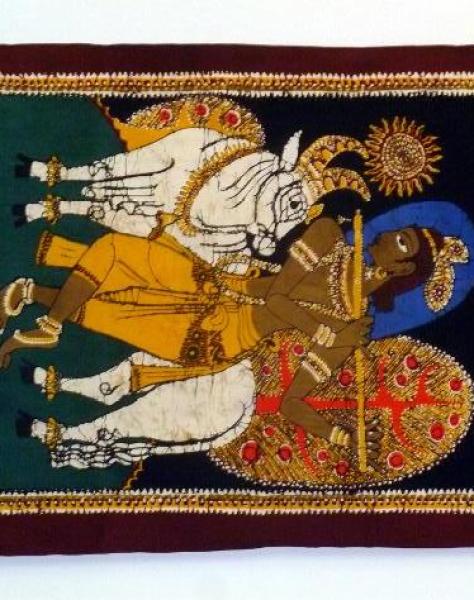
    Who’s Art? No, not Art. Art, like in artwork. Week by week I’ve been putting up more and more of the stuff that’s been in boxes for the last six to ten years. Or longer. Like this batik that my Dad bought ages ago and no one ever had a place to put it.

    Peacock batik

    It brightens up the powder bath, don’t you think?

    This Dancing Rama batik is one that I hung in my house in Oklahoma, but it’s been in storage since I left.

    Dancing Rama batik

    But the pieces I really wanted to get up were two stained-glass windows.

    Stained glass windows

    My Dad and I found them in the feed room of an old chicken coop that used to be on our property in Denver. We had no idea where they’d come from or how old they were. A neighbor who did stained glass rehabilitated them, and years later they hung in a north-facing window in the house my parents moved to. But then they went into storage and had rarely seen the light of day until a few months ago.

    I asked my cabinet builder, Jeff McClain, to tighten up the frames a bit.

    Stained glass windows close-up

    Speaking of Jeff, he also delivered this display cabinet for the “oriental” bedroom recently.

    Oriental bedroom display cabinet

    Little by little, the house comes together.

    Save

    Save